
The Higher Narrative AI Futures Framework (v1)
A method for moving an organization from scattered AI activity to a governed, enterprise-wide decision system.
The premise
AI transformation is not a technology problem. It is a narrative problem — a shift in how an organization understands itself and expands its capacity to work with emerging futures.
Narrative here does not mean messaging. It means the shared story through which an organization decides what AI is for, what it may influence or decide, who is accountable, and which futures it is willing to build.
Most AI programs fail — not mainly because of a lack of technological literacy, but because the organization never resolved a prior question: not which AI tool should we buy?, but what kind of decision-making organization do we want to become?
In practical terms: We use multiple AI futures to identify actions that are valuable across conditions, make reversible experiments, and preserve the ability to adapt as conditions change.
Structure
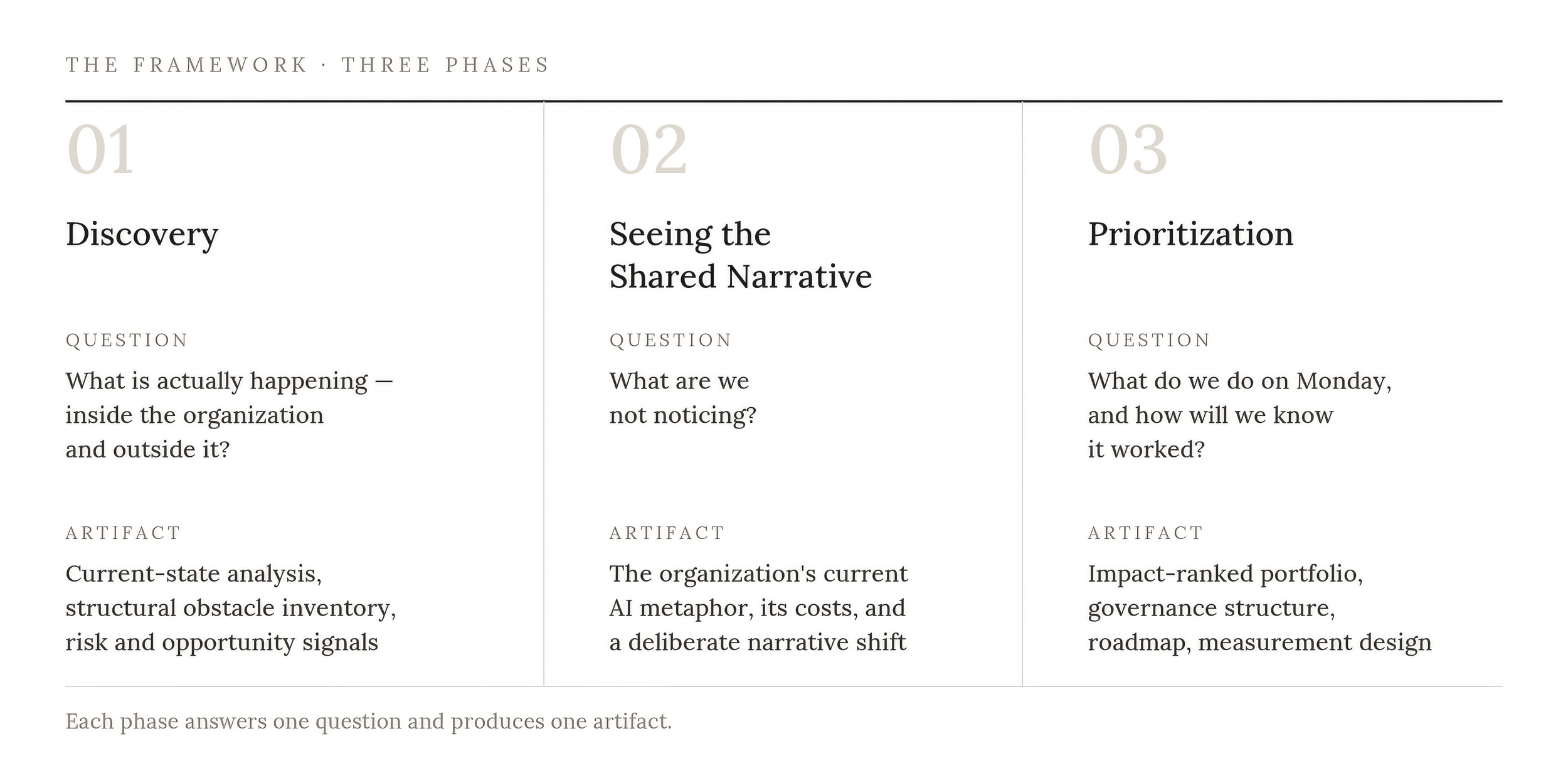
Phase 2 is not a reflective detour. Organizations do not hold neutral positions on AI — they hold a myth, an inherited story that determines which questions get asked and which risks feel real. The myth sits upstream of the roadmap. Change the roadmap without touching it and the organization reproduces the same decisions in new vocabulary. What surfaces here becomes the specification for the governance that follows.
The operating method
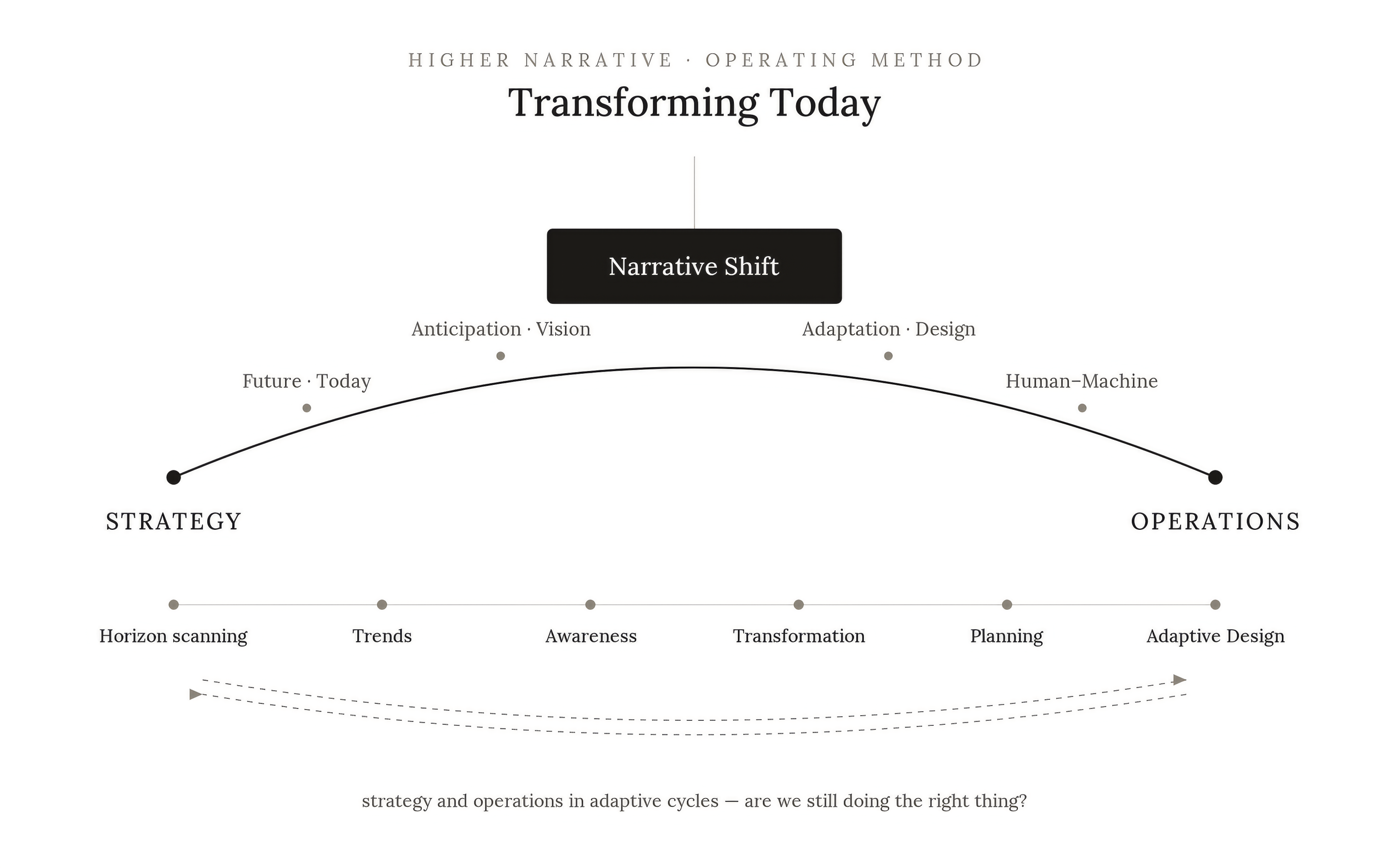
Two capacities sit at either end: anticipation — reading what is emerging before it arrives — and adaptation — changing how the organization actually works. Most organizations have one and not the other. Anticipation without operations produces documents nobody uses; adaptation without foresight produces efficient movement in an unchosen direction. The narrative shift at the centre is what lets the two inform each other rather than compete for budget.
Why adaptive rather than fixed: an organization will never be fully ready for this transition. A fixed roadmap assumes a stable target. The working assumption here is that the target moves — and that the capacity to re-decide is worth more than any single decision. The intent is that the loop keeps running after the program ends.
Governance layer
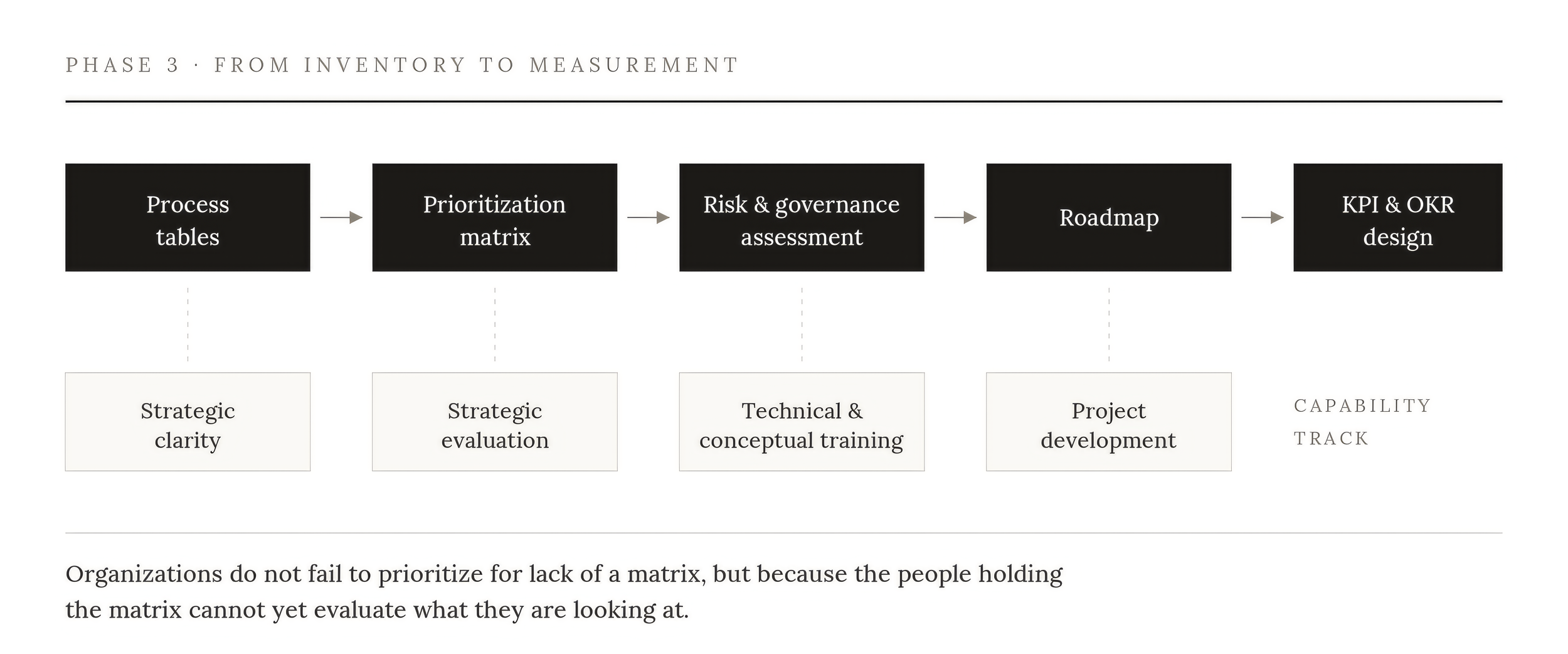
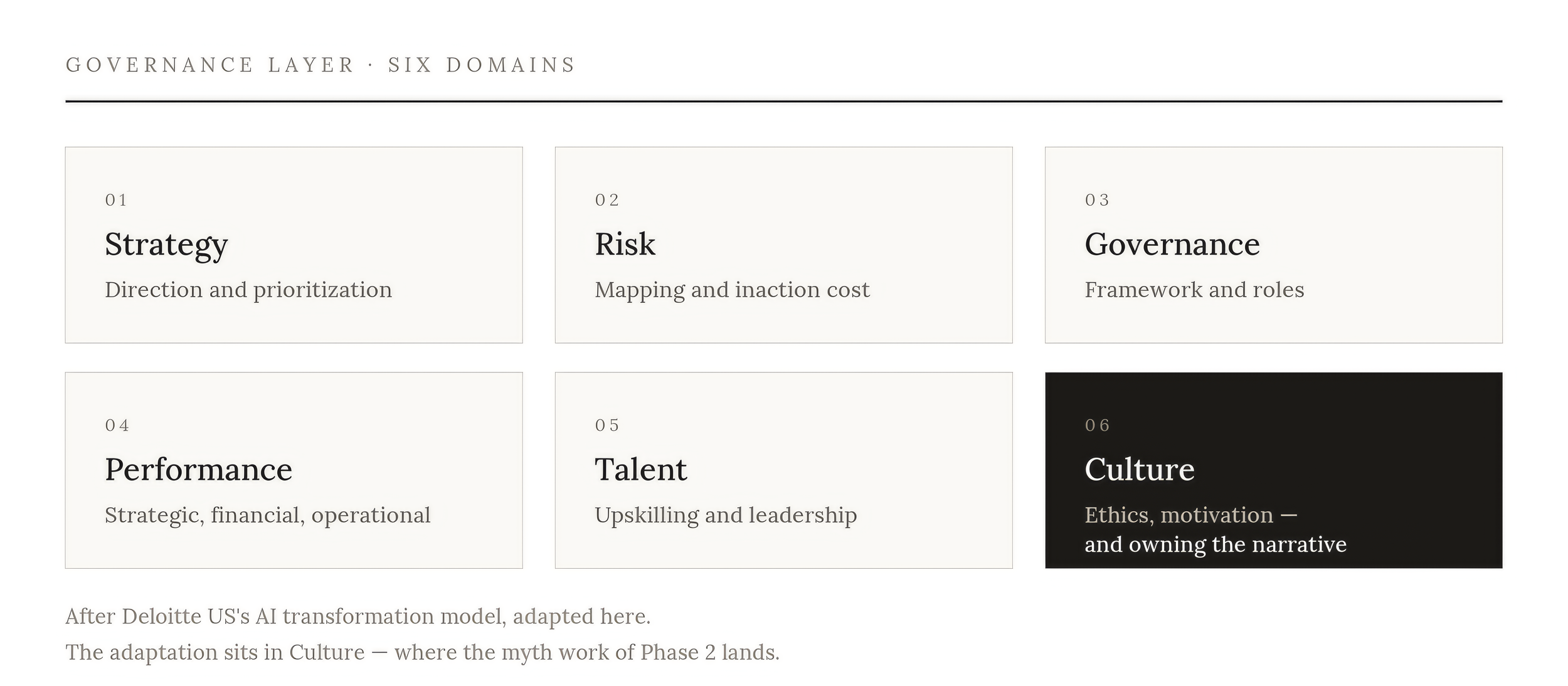
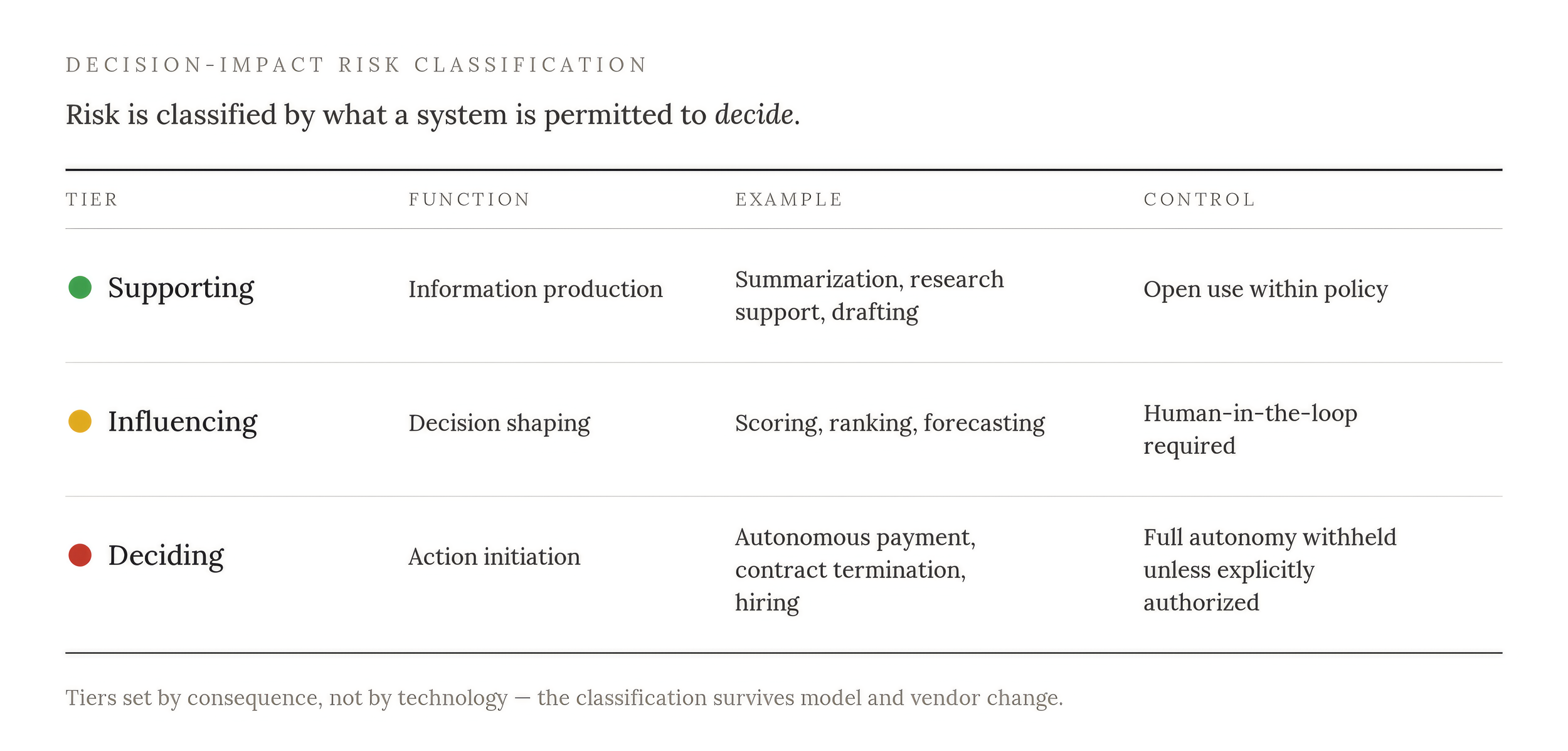
Three instruments, each derived from what the layered analysis found. The components are conventional; which one an organization needs, and why it has not already adopted it, is what the method establishes.
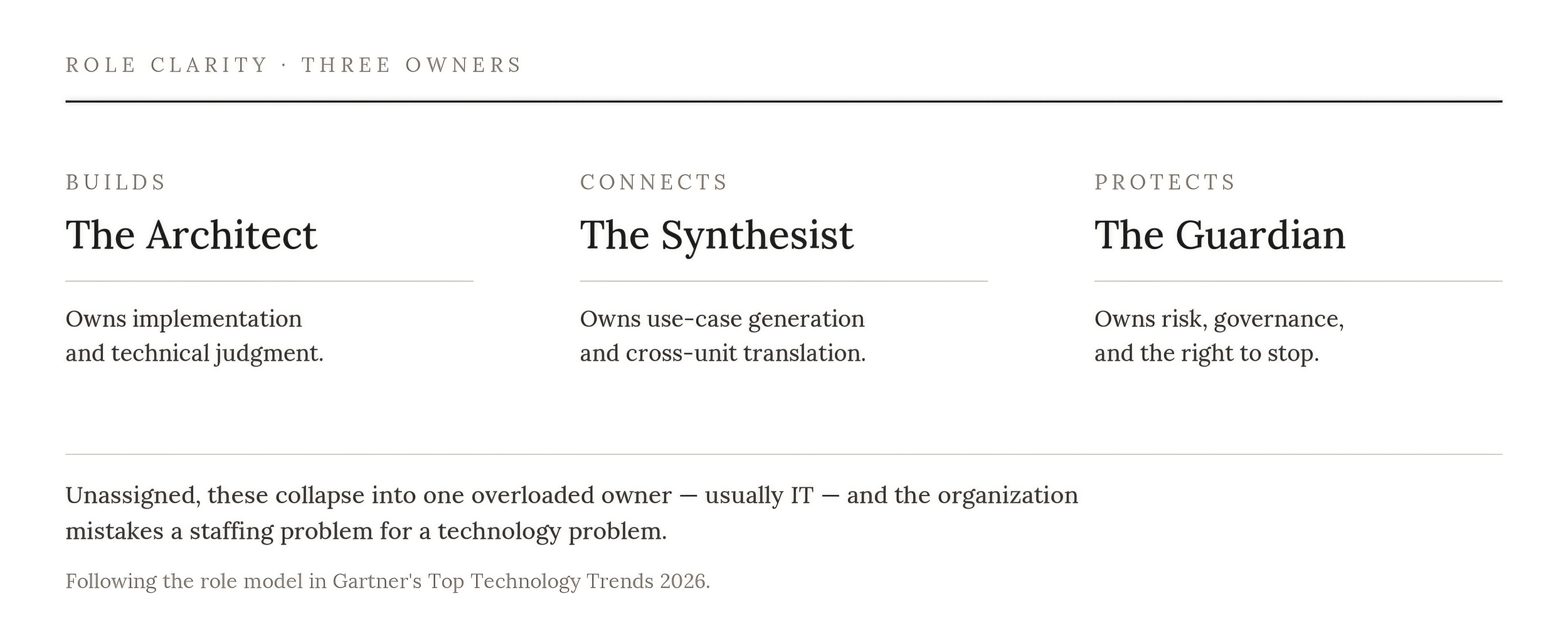
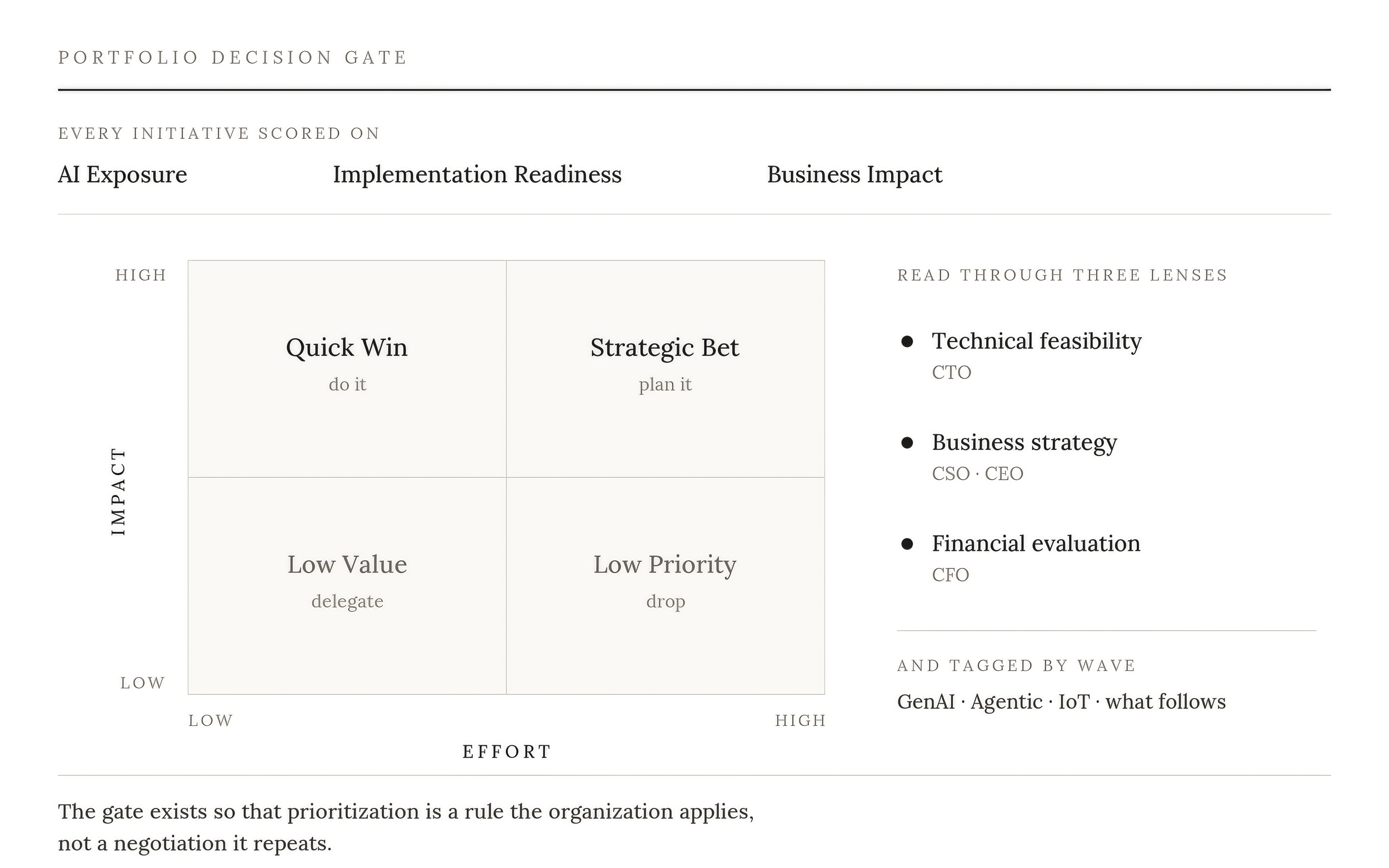
Why three lenses. Unit managers optimize for making their own work easier — reliably, and not unreasonably. Without a lens that asks what the organization as a whole is trying to become, a portfolio fills with locally rational projects that add up to nothing.
Why wave tagging. It shows which parts of the portfolio are betting on a wave that is cresting and which on one that has not arrived — and it anticipates the shift from AI as discrete projects to AI as infrastructure, after which a project-based inventory stops describing anything useful.
Lineage and contribution
The analytical layer draws on Causal Layered Analysis, developed by Sohail Inayatullah (1998), adapted here for organizational AI strategy. Its theoretical basis is developed in two publications by the founder & researcher:
Şimşek, A. Knowing Futures: CLA, Heidegger, and Somatic Intelligence in the Age of AI. Journal of Futures Studies.
Şimşek, A. (2025). Sadvipra Leadership in a Technofeudal Age: A Neohumanist CLA of Artificial Intelligence — The Neohumanist Review
Şimşek, A. (2025). Yapay Zeka Çağında Kurumsal Anlamı Yeniden Yazmak — Harvard Business Review Türkiye (in Turkish)
The three AI myths used in Phase 2 — god, monster, mirror — are developed in that work. This framework is their operational form.
The governance instruments are not claimed as original. Risk tiering is established practice; the six-domain model is adapted from Deloitte US; the role model follows Gartner; weighted scoring against a prioritization matrix is conventional portfolio management. The framework complements existing guidance rather than restating it.
What is original is the derivation. Most organizations already have access to these instruments and have not adopted them. The layered analysis establishes why — which question the operating narrative has made unaskable, and therefore which instrument will hold once installed and which will be quietly ignored. Governance fails more often from narrative mismatch than from poor design.
The session design, diagnostic instruments, scoring logic and question sets are Higher Narrative's own and are applied in engagement.
Deployment record
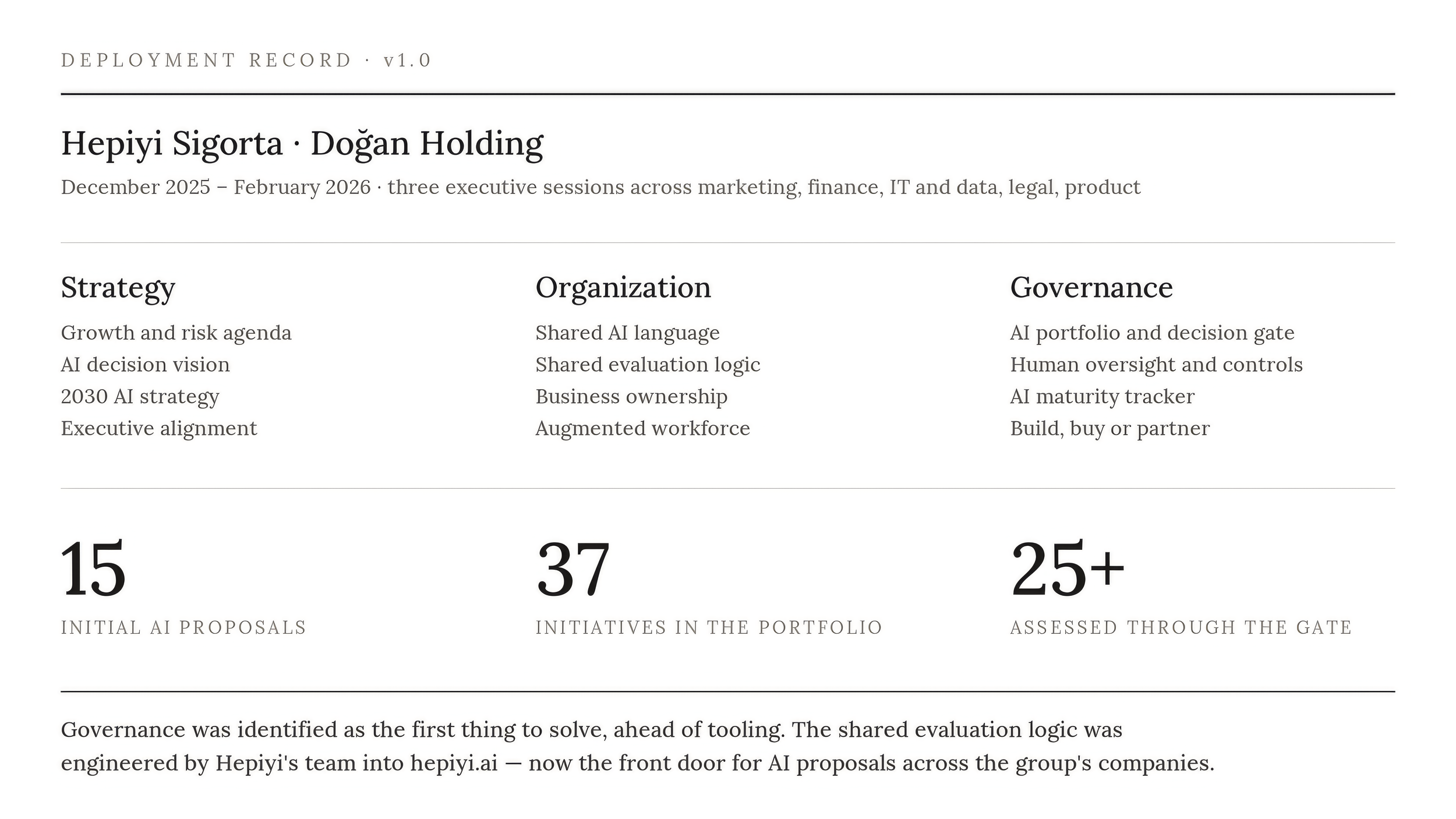
“The approach taken by Higher Narrative was truly holistic, treating AI as a cultural and managerial evolution rather than a mere IT project. Through the workshops, we bridged the gap between different levels of decision-makers, fostering a common language essential for innovation”
What this framework doesn’t do
It does not select vendors, produce a technology architecture, or replace domain expertise in the organization it enters.
This page describes the logic of the method. The diagnostic instruments — process inventory schema, scoring weights, session design, and question sets — are applied in engagement.
Next steps
To discuss an executive briefing, a diagnostic session, or deployment with your leadership team — contact us
Foundations
Sources that inform the framework. Context and grounding.
Method lineage
Inayatullah, S. (1998). Causal layered analysis: Poststructuralism as method. Futures, 30(8).
Futures Literacy — UNESCO
Şimşek, A. Knowing Futures: CLA, Heidegger, and Somatic Intelligence in the Age of AI — Journal of Futures Studies
Şimşek, A. (2025). Sadvipra Leadership in a Technofeudal Age: A Neohumanist CLA of Artificial Intelligence — The Neohumanist Review
Şimşek, A. (2025). Yapay Zekâ Çağında Kurumsal Anlamı Yeniden Yazmak — Harvard Business Review Türkiye (in Turkish)
Governance context
Attributed components
State of AI in the Enterprise — Deloitte, 2024 (six-domain structure)
Top Technology Trends 2026 — Gartner (executive role model)
The framework structure on this page may be referenced and cited with attribution to Higher Narrative. Commercial deployment, training, and certification are licensed.
Higher Narrative · highernarrative.com · asli@highernarrative.com
Version 1.0. Under active development. Changes will be versioned and dated.